
Quiet Firing: What to Do When Your Employer Wants You to Quit
When an employer decides to part ways with you, it’s a legal minefield for them. Firing someone triggers financial obligations, opens the door to unpredictable litigation, and they face the harsh reality that Ontario courts have become increasingly strict when it comes to determining whether a termination clause is enforceable.
Most employees are automatically entitled to common law reasonable notice, which can be substantial. To avoid this, employers try to use termination clauses to limit their liability to statutory minimums under the Employment Standards Act, 2000 (ESA). But because the employer is usually the one drafting the contract, the law places the burden on employers. If they even make a small, inadvertent mistake, the entire termination clause is unenforceable, and your entitlements default back to the common law.
In short, firing you is expensive and employers know that even a well drafted termination clause may not save them.
But if your employer can get you to quit, most of the risk vanishes. You aren’t owed a severance package, and they don’t have to worry about whether your termination clause is enforceable. They get what they want and don’t have to pay a thing.
This is the hidden math behind quiet firing. It is an often deliberate tactic used to limit your employer’s liability. But what many employees don’t realize is that quitting doesn’t always mean that your employer can get off without any consequences. You may still be entitled to a severance package if your employer crosses the line in pressuring you to quit.
Quiet Firing: How it Can Trigger a Constructive Dismissal Claim
In plain terms, constructive dismissal occurs when an employer doesn’t technically fire you, but they alter your job so fundamentally that the law treats their actions as a termination anyway. Legally, it requires three things:
Your employer makes a unilateral and substantial change to an essential term of your employment contract.
You do not agree to those changes.
You choose to leave your employment rather than accept them.
Not all forms of constructive dismissal are part of a deliberate quiet firing strategy. For instance, failing to investigate or prevent workplace harassment could lead to constructive dismissal, even though the employer may not be trying to get you to quit (though it could be part of their strategy).
Quiet firing, however, is almost always calculated. It is a coordinated set of changes designed to make staying with the company undesirable. Sometimes it’s a targeted campaign against you specifically, but other times it’s part of a broader strategy to get enough people to quit within the organization and reduce their headcount.
Here are the most common ways employers try to quiet fire their team:
Compensation Cuts: While cutting your base salary or hours is an obvious violation, employers often try to make more subtle changes such as overhauling your bonus structure, commission metrics, or eliminating stock options. As a general rule in Ontario, an overall reduction in your compensation by 10% or more can trigger constructive dismissal.
Role Restructuring (Quiet Demotion): Your company might reorganize your department and quietly strip away your authority, direct reports, or key responsibilities. Drastically reducing an employee’s duties, even if their pay stays exactly the same, can still trigger constructive dismissal.
Relocation: Requiring you to report to a different office that drastically increases your commute can also be constructive dismissal. Context matters, so a change in office location may not automatically trigger constructive dismissal, but a major change likely will.
Return to Office Mandates: While employers generally have the right to recall workers if they provide sufficient notice, the landscape changes drastically if you were hired as a fully remote worker. If your contract states that you are remote, a unilateral demand to come into an office can be a fundamental breach and trigger constructive dismissal.
Context is Key
Constructive dismissal is a highly context-specific claim. The presence of just one of these factors won’t automatically guarantee that you have a strong claim.
For example, moving your office to a building a couple of blocks away might have a negligible impact on your life, whereas moving it to the next city over could double your commute and trigger a claim. Similarly, a drop in your commission might not be constructive dismissal if your overall compensation remains the same (e.g. you receive an increase in your base salary), or if the real reason for a drop in your income is because of market forces beyond your employer’s control.
Because the line between a minor corporate change and an illegal breach is so fine, the worst thing you can do is to act on impulse. If you see some of the warning signs and think you might be the victim of quiet firing, speak to a lawyer.
When is it Reasonable to Quit?
Whether we’re talking about compensation, role restructuring, relocation, or return to office, the law applies a standard of reasonableness when determining whether you have a claim for constructive dismissal.
In short, a court will look at whether a reasonable person in your position would consider the change fundamental, justifying you quitting and treating your employer’s action as constructive dismissal. Importantly, it matters what a reasonable person would think at the time the change occurred. Hindsight is 20/20, but the law doesn’t expect you to predict the future. If, based on the information available to you at the time, all of the evidence points to the change resulting in a pay cut, you won’t be punished by the courts if your employer can demonstrate that your pay would have actually gone up based on real world data. To put it simply, if it looks like a duck and quacks like a duck, it’s legally a duck, even if later evidence shows that it wasn’t, in fact, a duck.
If you’re considering walking away from your job:
Don’t resign without legal advice. These types of claims are incredibly fact specific, and you should work with your lawyer to plan ahead for your claim.
Document everything. Whether it’s letters or emails from your employer, notes from calls, or any important dates, keeping a clear file can make it easier to litigate your case.
Act within a reasonable time. The longer you wait before objecting to a change in your work conditions, the easier your employer will be able to argue that you accepted the changes.
Not all changes qualify. Minor inconveniences or management decisions don’t count as constructive dismissal. Consult with a lawyer before you act.
Authenticity at Work
Pride is about more than corporate logos and rainbows. For queer professionals, it’s about the exhausting math we have to do just to show up to work.
Years ago, as a second-year law student, I was interviewing for an articling position. I had been told that the particular market I was interviewing in was self-conscious about their proximity to Toronto and how that market was often a second choice or backup plan rather than somewhere new lawyers actually wanted to spend their career. Why hire young associates who would work for two years and then inevitably flee to Toronto for better pay?
I wasn't originally from that city. My only anchor to the community was my then-husband.
So, during the interview, I made a conscious, strategic decision. I mentioned my husband in passing. It served two purposes:
It proved I had a legitimate, long-term reason to stay in the city.
It was a culture check. I wanted to see if I would be welcomed as my full self.
The reaction was immediate. The interviewer—a middle-aged woman—essentially stopped the interview. She looked at me and asked why I had just outed myself. She told me, "You should never bring your personal life to work."
Here is the double standard: If a straight candidate had mentioned their wife in that exact context, it wouldn’t have been viewed as a political statement or bringing their personal life to work. It would have been viewed as a sign of stability. It would have been a checkmark in the "will stay long-term" column.
But because I was a gay man, sharing the exact same human context was treated as a professional liability.
(And for the record? We eventually broke up, and I did exactly what they were afraid of—I moved to Toronto and later built my own firm.)
When I talk about running a trauma-informed employment law practice, this is where it comes from. I don't just know the Employment Standards Act; I know what it feels like to have your identity evaluated as a risk factor. I know the anxiety of wondering if you can be honest about who you are at the water cooler (or in an interview), or if a subtle shift in your boss's demeanour is tied to who you love.
When clients come to my firm, they don't have to translate their lives or filter their experiences. Part of my motivation in starting my own practice was and is to do law differently. If you can’t be open and honest with your lawyer, and feel welcome to share your full self without judgment, their advice won’t actually reflect the reality of your situation. I have built my practice to be different; it’s based on my own experiences that go beyond just knowledge of the law.
Let’s keep building workplaces where no one is told to leave their humanity at the door.
Happy Pride!
Beyond the Credentials: 10 Traits to Look for When Hiring an Employment Lawyer
Navigating an employment dispute is never just a legal issue; it is a deeply personal one. Our careers are tied to our livelihoods, our identities, and our sense of security. When that is threatened by a sudden termination, a toxic work environment, or discrimination, the lawyer you choose to stand beside you matters.
Having founded my own firm, I realized early on that the traditional legal model often gets it wrong. Too many firms treat clients like file numbers on an assembly line. I believe that effective advocacy requires a deeply human-centric approach.
If you are looking for an employment lawyer, here are the 10 critical traits you should look for to ensure you are getting the representation you deserve:
1. Interpersonal Alignment
While legal directories will tell you about a lawyer’s degrees, the most underrated aspect of hiring a lawyer is mutual alignment. Simply put: you need to work with someone you genuinely click with. Employment law requires you to share vulnerable, often stressful details of your life. If you don't feel at ease and trust your lawyer during the initial consultation, they aren't the right fit.
2. A Trauma-Informed Approach
Job loss, workplace harassment, and discrimination can be profoundly traumatic. A great employment lawyer doesn't just look at the cold, hard facts of a case (though this matters as well); they understand the psychological toll the situation is taking on you. Operating a trauma-informed practice means I recognize the emotional weight of your experience. Your lawyer should prioritize your well-being and tailor their strategy to you.
3. Clear, Accessible Communication
The law is notoriously filled with complex jargon, but your legal strategy shouldn't be a black box. One of the most important traits of a great lawyer is the ability to translate legalese into plain, understandable language. Your lawyer should empower you to make an informed decision that you understand and feel comfortable making.
4. A Commitment to Client Experience Over Volume
Many traditional law firms operate on a high-volume model, churning through cases as quickly as possible. You deserve better than to be just another file on a crowded desk. Look for a lawyer who prioritizes the quality of the client experience over the quantity of their caseload. In my practice, limiting volume means I can give my clients the dedicated time, responsiveness, and attention their cases truly deserve.
5. Lived Experience and Authenticity
The best advocates draw from more than just textbooks; they draw from life. As a gay lawyer, I bring a personal understanding of the nuances of navigating workplace dynamics, marginalization, and bias. Finding a lawyer who brings their authentic self to the table often means finding someone who can spot the subtle dynamics of workplace inequality that others might miss.
6. Focused, Dynamic Experience
It is easy to assume that a lawyer with 30 years of experience is automatically the best choice, but in a rapidly evolving field like employment law, focused experience is what truly matters. Over my four years of dedicated practice in this field, I have immersed myself entirely in the modern employment landscape. When you hire an agile, highly engaged founder rather than a senior partner who will pass your file off to a junior associate, you get a lawyer who knows every intimate detail of your case and is fiercely motivated to win.
7. Unvarnished Honesty
Your lawyer should be your advocate, not your cheerleader. A trustworthy lawyer will be transparent about your prospects for success, the potential risks, and the realistic costs involved. You need someone who will give you practical, grounded advice based on the facts of your case, rather than just telling you what you want to hear.
8. Deep Empathy and Supportiveness
Employment lawyers, more than those in most other fields, must be acutely sensitive to how essential a job is to a client’s life. Your lawyer must be a willing listener. Before arriving at conclusions about the strength of a claim, they need to hear your story and understand your goals. What may be a great outcome for one person may involve too much risk for another, and may not push hard enough for yet another person.
9. Direct Accessibility
When you are in the middle of a workplace crisis, you shouldn't have to jump through hoops, receptionists, and paralegals to get a quick update. You are entitled to prompt, responsive communication. A hallmark of a great boutique firm is the ability to offer direct, reliable access to the lawyer actually handling your case. I have designed my firm to prioritize communication through the most effective method for each particular client.
10. Client-Centered Results
A traditional lawyer focuses strictly on the financial bottom line, but a truly results-oriented lawyer focuses on your definition of a win. Whether your goal is a swift and quiet settlement to protect your peace of mind, or holding a toxic employer fully accountable in court, your lawyer should pursue the resolution that serves your specific, holistic needs.
Finding the right employment lawyer is about finding a strategic partner. It’s about trust, communication, and a shared vision for your future. Don't settle for anything less.
AI Contracts : Not Worth the Risk
AI can be a wonderful tool. It can make your workplace more efficient, give you a quick answer to a problem you’re facing, or just give you somewhere to start. But while using AI to save you time or money when drafting employment agreements may seem like a holy grail, it is likely exposing your company to more risk in the long term than hiring a lawyer in the first place.
Here at Alinea, we ran a little experiment to see how three of the most used AI tools dealt with a common issue: drafting an enforceable termination clause.
Drafting enforceable termination clauses in employment agreements is probably the leading cause of employment litigation. Courts in Ontario are increasingly holding employers to a high standard to ensure that there is no attempt to contract out of ESA entitlements. And counsel for employees are creative in developing new arguments that poke holes in these clauses.
Experiment: How does AI do?
To test how AI performed, we asked Gemini, ChatGPT, and Co-Pilot to draft an enforceable termination clause. Here’s what we asked:

All three had the same problem; they allowed employers to terminate employees “at any time”, a phrase that has been under scrutiny since 2024. These three words could potentially cost your business tens or hundreds of thousands of dollars in termination costs and legal fees.
The issue is that “at any time” could be interpreted to mean an employer can terminate an employee right after they submitted an ESA complaint, went on a protected leave, or made a workplace harassment complaint. Even if that was never the intention of the clause, the meaning of the clause is ambiguous and could be interpreted as attempting to contract out of the ESA.
For instance, take a look at the clause generated by ChatGPT:
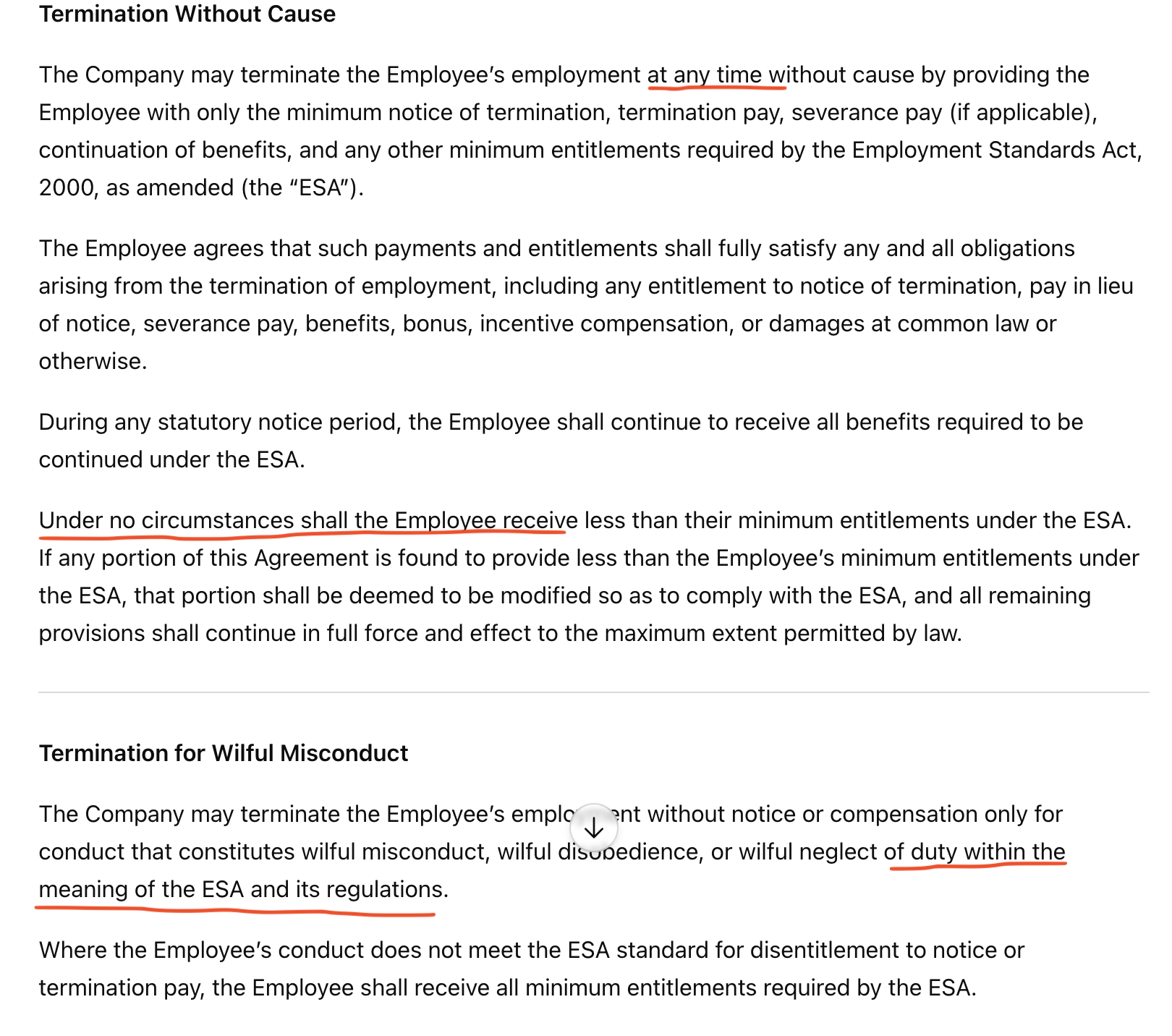
This clause is relatively straightforward. It limits termination entitlements to ESA minimums, includes a saving clause that states that the employee will always be entitled to their ESA minimums, and defines termination for cause narrowly.
But by using the term “at any time”, this clause would very likely be found to be unenforceable (or at the very least, your employee’s lawyer will claim that it’s unenforceable), leading you down the path to litigation.
And even though it includes a saving provision, Ontario courts will generally not give it any weight.
Termination for Cause
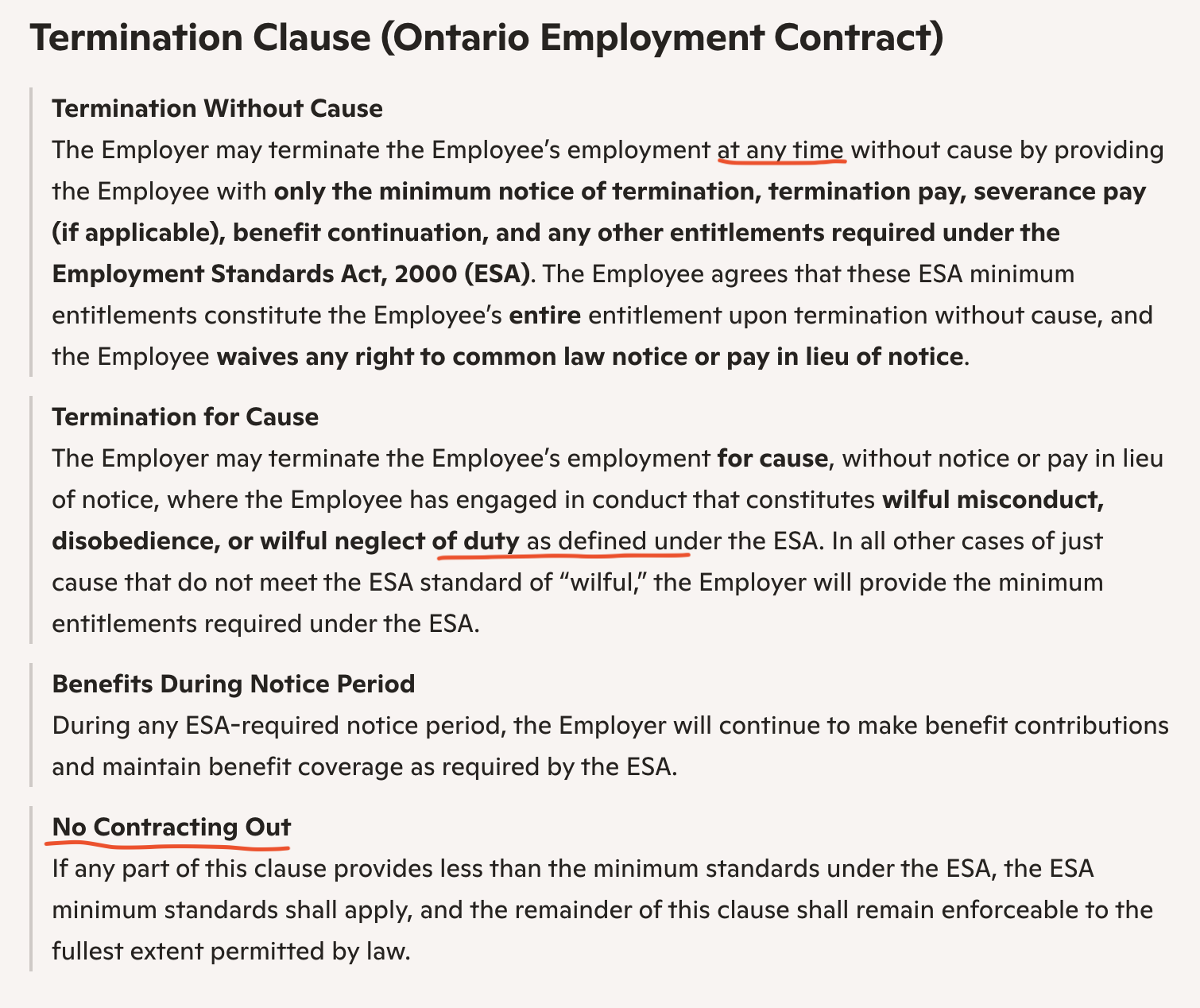
Another issue that ChatGPT and Co-Pilot had was with their definition of “for cause” termination. On its face, the clause provided by ChatGPT seems to do a good job. It correctly tried to limit “for cause” terminations to the wording found in O Reg 288/01. The problem is that it left out part of the definition.
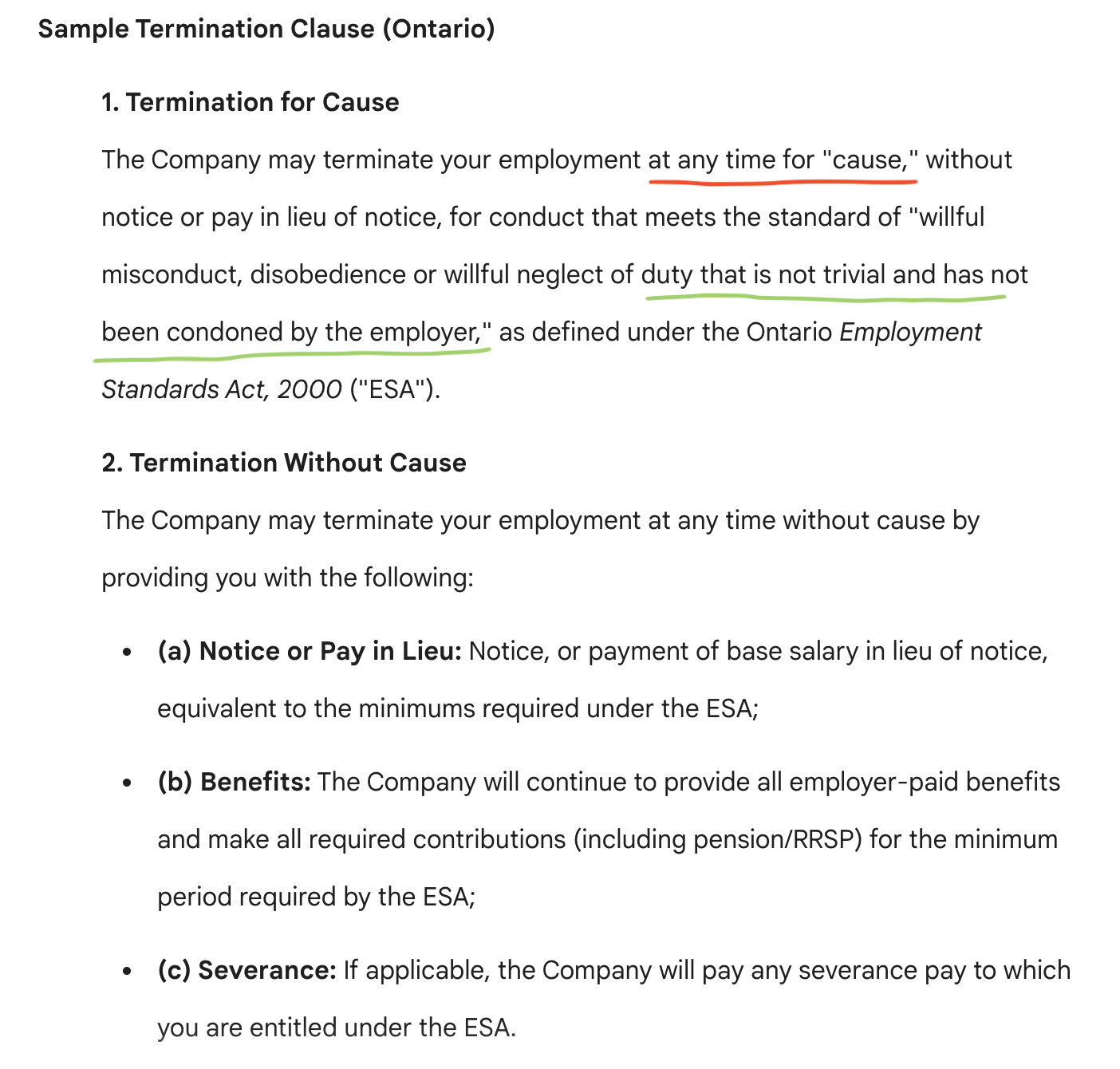
The Regulation states that an employee may be terminated without notice due to wilful misconduct, wilful disobedience, or wilful neglect of duty that is not trivial and has not been condoned by the employer. Although ChatGPT says that these terms are defined by the ESA and its regulations, the omission of the second half of the definition could render the termination clause unenforceable.
Co-Pilot has the same issue that Chat GPT produced:
Of the three, only Gemini included the full definition (underlined in green):
Why does this matter? Drafting an enforceable termination clause isn’t just about drafting a clause that ends up holding up in court. Most cases never make it that far. Your real risk with these clauses lies in the uncertainty that they produce. Any minor deficiency give your former employee’s lawyer something to latch onto, giving them room to negotiate a settlement favourable to their client.
Litigation is expensive. It’s often not worth fighting a case through to a trial where you will be on the hook for your own legal fees, an order against you, and part of the employee’s legal fees. That’s why most cases settle. The goal of a well-drafted termination clause is to reduce the ammunition the other side will have to give your business a more predictable settlement range.
Other Pitfalls
And these are just the problems with a single clause. If you’re letting AI draft your entire agreement, it will likely contain countless other mistakes, or just miss something altogether. And that’s not even considering other documents that you need for your business from workplace policies, termination notices, job posting requirements, commission and bonus plans, performance and behaviour management documents, accommodation agreements, releases and settlement documents.
Using AI may seem like it’s saving you time and money on hiring a lawyer, but it may result in higher costs long term, and more protracted litigation.
Alinea On-Call
That’s why Alinea has a subscription service for employers. We give you access to the legal advice you need for your business so you don’t have to rely on AI to draft your documents, all for a predictable monthly rate based on the needs of your business. The goal is to make legal support accessible for businesses of all sizes. It’s like having your own in-house counsel, but without the cost of hiring a full-time lawyer.
Reach out by email, phone, or schedule a free consultation to learn more about Alinea On-Call and ask about our introductory offer.
Independence in Investigations: A Review of Stobo v Queen’s University
Litigation is a nightmare for employers, but preparation is your best defense. Taking proactive, smart steps now can fast-track a resolution if (or when) a legal dispute lands on your desk.
Stobo v Queen’s University, 2026 ONSC 2253
A recent decision from the Ontario Superior Court of Justice cuts right to the heart of workplace investigation independence. The case involved an urgent motion to block a university’s appointed investigator in a workplace harassment complaint.
The dispute started after a complaint was filed by university employees against a student and a community member, both users of the university’s Athletics & Recreation Centre (“ARC”). Amidst the process, the community member also raised allegations of discrimination.
Since the original complaint was workplace-related, the university was legally obligated to conduct an “appropriate” investigation under the Occupational Health and Safety Act. Given the claims involved non-employees (a student and a community member), the university made the decision to hire an outside investigator.
This is standard practice in high-stakes claims, where litigation is expected, or where a conflict of interest could create a reasonable apprehension of bias. The university even offered to investigate the plaintiffs' discrimination claims as part of the process, but they never responded. In this case, hiring an independent investigator was unequivocally the right call.
Escalation and the Court’s Verdict
Despite the university’s move for independence, the plaintiffs challenged the investigator's appointment, claiming the independence of the investigation would be 'tainted'. They filed an urgent motion seeking an injunction to prevent the university from using that specific investigator.
The court dismissed the motion, finding zero basis for the assertion of bias. The plaintiffs' argument hinged on one minor, quickly corrected procedural error; the university had mistakenly filed a Notice of Intent to Defend on behalf of all defendants. This administrative slip was fixed within 24 hours when the investigator filed his own notice and the university filed an amendment on behalf of the remaining defendants. A minor, corrected mistake was not nearly enough to create a perception of bias.
Crucially, the court emphasized that it will not intervene when an organization has proper investigation policies and procedures in place, unless "rare circumstances" exist.
So although this case ended up in a courtroom, by doing all the right things, the employer ensured a quick resolution and favourable outcome.
Takeaways
External Investigators Work: Hiring an outside investigator for high-stakes claims, anticipated litigation, or where bias might be perceived (like a complaint against a non-employee), can help protect the integrity of the process
Procedure is Protection: Having established policies and procedures for conducting investigations is essential.
Minor Slips Won’t Taint: A minor, quickly corrected administrative mistake will generally not be enough to persuade a court that an appointed investigator is biased.
Coca-Cola Termination Part 2: Accommodation and Undue Hardship
In Part 1 of this series, we explored the doctrine of Frustration of Contract—the legal concept Coca-Cola used to justify the termination of Shawne Hopkins, a 35-year employee of the company, following a workplace injury.
Today, we look at a related concept: the duty to accommodate. When Coca-Cola ended Mr. Hopkins' employment, they reportedly claimed that not only was the contract frustrated, but that accommodating his resulting disability had reached the point of undue hardship. But what does that actually mean in the eyes of Canadian law?
The Broad Definition of Disability
To understand the duty to accommodate, we must first understand what the law considers a "disability."
The legal definition of a disability in employment law is very broad. It has been consistently interpreted to include temporary injuries or illnesses, which could include anything from workplace injuries, any physical injuries that restrict an employee’s ability to perform their duties, mental health conditions, and ongoing chronic illnesses, to what people would ordinarily think of as a disability, whether mental or physical, and even to temporary “conditions” like pregnancy. In the landmark Supreme Court case Québec v. Montréal, 2000 SCC 27 (often referred to as the Mercier case), Justice L’Heureux-Dubé emphasized that the goal is to eliminate arbitrary exclusion:
“The purpose of Canadian human rights legislation is to protect against discrimination... its more specific objective is to eliminate exclusion that is arbitrary and based on preconceived ideas concerning personal characteristics, which... do not affect a person’s ability to do a job.”
A Dialogue of Flexibility: The Accommodation Process
The duty to accommodate isn't a one-way street; it is a collaborative process. It requires a sincere dialogue between the employer and the employee to find a solution that allows the worker to continue contributing without causing the employer undue hardship.
This could play out in any number of ways like:
Allowing an employee to work from home on days they have medical appointments;
Modifying a work schedule to allow for physical therapy; and
Lightening physical duties or providing specialized equipment.
While an employer is required to arrange the workplace or adjust duties, there are limits. They are generally not required to change the fundamental nature of the employment relationship—for example, by creating a brand-new, unproductive position that didn't previously exist.
The High Bar: What is Undue Hardship?
The central question is always: How far must an employer go? This analysis is highly context-specific. What constitutes undue hardship for one employer might be reasonable for another. Common factors include:
Financial Cost: Would the accommodation be so expensive it threatens the viability of the business?
Interchangeability of the Workforce: Can other staff members take on certain tasks?
Rights of Other Employees: Does the accommodation significantly interfere with seniority rights in a unionized environment?
The Size Factor
This is where the Coca-Cola case becomes particularly interesting. A small business with five employees performing heavy labour may find it easy to prove undue hardship if a worker can no longer lift heavy objects. There simply may be no other work available.
However, for a giant like Coca-Cola, the bar is significantly higher. The Supreme Court's 2008 Hydro-Québec decision noted:
“If a business can, without undue hardship, offer the employee a variable work schedule or lighten his or her duties - or even authorize staff transfers - to ensure that the employee can do his or her work, it must do so to accommodate the employee.”
In a large company, there is a much higher chance that the company will have administrative roles that do not require physical labour, allowing the company to reassign a worker to a role at around the same level or pay scale, without any other significant burden. They may face higher costs from retraining the worker, but unlike the small business that may not even have such a role, the relative burden is low.
Applying the Test
Based on the facts reported by the CBC, Mr. Hopkins was cleared by the Workers’ Compensation Board to return to work, albeit in a different role. Meaning that he we know that his disability is not so severe that it prevents him from returning to work full stop.
Given Coca-Cola’s resources and various types of positions that are likely available (both physical and administrative), it seems unlikely that a suitable role could not be made available or modified. While chronic absenteeism can eventually discharge the duty to accommodate if the employee can no longer perform the core of their job, that doesn't appear to be the situation here.
If there was no genuine attempt to find an alternative role for a 35-year employee who was medically cleared to work, the company may struggle to prove they reached the point of undue hardship.
The Missing Piece: Workers’ Compensation
In Ontario, the duty to accommodate under the Human Rights Code is only part of the story. For workplace injuries, the Workplace Safety and Insurance Act (WSIA) adds an extra layer of protection: the Statutory Duty to Re-employ.
In Part 3, we will conclude this series by looking at how Workers’ Compensation boards—and specifically the WSIB in Ontario—enforce the return-to-work process.
Facing an accommodation issue at work? Whether you are an employer trying to navigate the "undue hardship" bar or an employee being told your role can't be modified, I can help.
Disclaimer:The information provided in this blog is for informational purposes and does not constitute legal advice. If you are facing a situation involving disability or termination, please contact an employment lawyer to discuss the specifics of your case.
Coca-Cola Termination Part 1: Frustration of Contract
The recent story of Shawne Hopkins, a 35-year veteran of a Coca-Cola bottling plant in Calgary, has come as a shock to a lot of people. CBC News broke this story earlier this week on their “Go Public” investigative journalism segment. After three and a half decades of service, Mr. Hopkins was reportedly terminated via a brief phone call after sustaining serious injuries on the job. The company’s legal justification? Frustration of Contract.
While this case is unfolding in Alberta, it offers a critical teachable moment for employees and employers here in Ontario. In this first part of a three-part series, we examine the doctrine of frustration, the high bar set by the courts, and why Ontario’s legislative framework provides a safety net for injured workers. In Part 2, we will look at how the facts of this case would play out with the Duty to Accommodate under human rights law, and in Part 3 we will conclude with an overview of how Workers’ Compensation programs come into play.
The Facts
Before getting into the details of this case, we want to highlight that none of these facts have been tested in court or been determined by an arbitrator. While a grievance has reportedly been filed by the union representing Mr. Hopkins, it will likely take many months before we have a more complete picture of events, assuming this case doesn’t settle in the meantime. For this series, we will assume that the allegations as reported by the CBC are true for the sake of illustrating how the law would apply, but with the caveat that as facts change, the application of the law to the facts will also change.
According to reporting by the CBC, Mr. Hopkins was injured by a roughly 900kg door, injuring his left shoulder, arm, and neck. He claims to have brought up safety issues with the door to his employer in the past, but apparently nothing was done to rectify the safety concerns.
After two years on Workers' Compensation and undergoing surgery, he was cleared to return to work with restrictions by Alberta’s Workers’ Compensation Board (“WCB”). As part of this plan, he is receiving retraining as he still has limitations on the use of his arm.
But instead of a return-to-work plan, he was met with a claim of frustration of contract by Coca-Cola Canada Bottling Limited. When he was notified of his termination, he was offered a lump-sum payment of $2,511 in exchange for a release and non-disclosure agreement.
In a unionized environment, such as the one Mr. Hopkins worked in, the collective agreement dictates many of the procedural steps. However, the underlying principles of frustration of contract are applicable to all employment relationships under common law.
What is Frustration of Contract?
In employment law, frustration can be described as the legal death of the employment relationship. In that sense, it is unlike a termination or resignation, which occur when one party unilaterally ends the contract. Frustration occurs when an unforeseen event—which is not the fault of either party—makes the performance of the contract impossible or "radically different" from what was originally intended.
The Supreme Court of Canada established the modern test for frustration in Naylor Group Inc. v Ellis-Don Construction Ltd., 2001 SCC 58 [Naylor]. To successfully argue frustration, an employer must prove that the event giving rise to frustration:
Radically altered the contractual obligations of the parties;
Was not foreseeable and which the contract does not contemplate; and
Was not caused by the parties.
While frustration of contract can apply to any contractual relationship, we are applying the test as stated in Croke v VuPoint System Ltd., 2024 ONCA 354 [Croke], a recent decision from the Ontario Court of Appeal. The decision deals directly with the law of frustration of contract, applying Naylor, in the context of employment law.
Frustration of contract in employment law is usually the result of a permanent disability of an employee. In this context, there is an extra step in the test to determine whether an employee is permanently disabled according to the law. The important distinction is between permanent and non-permanent disability, rather than a clear-cut amount of time that has passed. In Hoekstra v Rehability Occupational Therapy Inc., 2019 ONSC 562 [Hoekstra], the court stated that this is a contextual analysis, meaning that all factors surrounding the nature of the illness and the likelihood of a return to work must be considered. Either party could assert frustration of contract a short amount of time after an illness or injury if there is no reasonable likelihood of recovery, whereas courts have recognize relatively long absences, up to five years, as temporary (Hoekstra, paras 28 and 29).
So, how does this test stack up with the facts as presented by CBC? On the face of it, because the WCB has cleared Mr. Hopkins to return to work (though with retraining for a new role), he is not so permanently disabled as to be unable to perform work for Coca-Cola. This is skipping ahead a bit to the accommodation process, but the “radical alteration” of the employment relationship from the first part of the test for frustration really means “the employee’s duty to perform work in exchange for remuneration.” (Hydro-Québec v Syndicat des employées de techniques professionnelles et de bureau d’Hydro-Québec, section locale 2000, 2008 SCC 43).
Even if we accept that the other parts of the test are met, Coca-Cola will face it’s main hurdle in proving that it could not accommodate Mr. Hopkins’ return to work under either modified duties or in another role. And even though frustration acts as an operation of law, it is up to the party alleging frustration to prove that the contract was in fact frustrated.
The Ontario Lens: The ESA and O. Reg. 288/01
But what if this were frustration of contract? One could be forgiven after reading the CBC article and worry that once your contract is frustrated, you are entitled to nothing from your employer. At least in Ontario, this is not the case.
While O Reg 288/01 generally exempts employers from paying notice or severance when a contract is frustrated, there is a critical exception to the exemption. Under sections 2(3) and 9(2)(b) of the Regulation, if the frustration is the result of an illness or injury suffered by the employee, the employer must still pay statutory termination and severance pay.
So at the very least, an employer owes statutory notice (or pay in lieu) under section 54 of the Employment Standards Act, 2000, and statutory severance under section 63 (statutory severance only applies to workplaces where either the employer has a payroll of $2.5 million or more, or if the employee is one of at least 50 employees terminated within a 6-month period with the employer).
The 35-Year Reality Check
For a long-term employee like Mr. Hopkins, the stakes are incredibly high. In Ontario, the ESA would entitle a 35-year employee to a minimum of 34 weeks (8 weeks of notice plus 26 weeks of severance). However, at common law, a 35-year tenure often pushes notice periods towards 24 months.
When an employer alleges frustration, the burden of proof lies entirely on them. If an employee has been cleared to return to work—even with restrictions—arguing that the contract is frustrated becomes a very steep uphill battle.
Coming Up Next
The claim of frustration cannot be viewed in a vacuum. It is inextricably linked to an employer's obligations to accommodate. In Part 2 of this series, we will dive into the Duty to Accommodate and the high legal threshold of Undue Hardship in Ontario.
Disclaimer:The information provided in this blog is for informational purposes and does not constitute legal advice. If you are facing a situation involving disability or termination, please contact an employment lawyer to discuss the specifics of your case.
Termination Packages: The Importance of Careful Legal Review
In the past, a termination package would be delivered to you in person, you would take it home, review it with your lawyer, and returned a signed copy. Only after going through all of those steps would you have a binding settlement. But with the business world and the legal world increasingly working with digital documents, it can be all too easy to accept an offer without thinking about it. As an employee, you may still think that until you sign a formal document, you haven’t agreed to anything.
But a brand-new decision from the Ontario Superior Court, Stribling v Starbucks Coffee Canada Inc., 2026 ONSC 1030, should warn employees just how easy it is to be bound by a termination package.
The Case: Stribling v Starbucks
Derek Stribling was a store manager at Starbucks. After some performance and health-related issues, Starbucks gave him a choice: return to work under a performance plan or accept a "voluntary mutual separation" package consisting of 8 weeks’ pay.
Mr. Stribling took time to think. He even asked for extensions to consult a lawyer. Then, on September 1, 2023, he sent an email to accept the offer of a voluntary separation. He wrote:
"I have decided to accept Starbucks' offer... including the details and compensation..."
He added that he would sign the formal release once he received it. However, after some back-and-forth over a clerical error in the paperwork (which Starbucks quickly fixed), he changed his mind. He didn't sign the release and instead sued for wrongful dismissal in November 2023.
The Court’s Verdict: A Deal is a Deal
Justice E. Iacobucci was clear: the moment Mr. Stribling hit “send" on that email, a binding contract was formed.
The court found that because the essential terms (the money and main terms) were clear and the acceptance was unequivocal, signing the formal Release wasn’t necessary to create a binding agreement.
Think about it like this: Let’s say you work for a company selling paper products, Dunder Mifflin say, and you sign a contract to sell paper to another company. The terms state that this company will owe Dunder Mifflin money as soon as you deliver the paper. But due to some reason (maybe you put the wrong price on the contract), you don’t want to be bound by the contract anymore and don’t deliver the paper. Your customer doesn’t owe you any money, but that isn’t the same thing as there not being a contract.
The Court in Stribling said essentially the same thing about the release. Mr. Stribling needed to sign a release before he could receive the payment promised under the separation agreement, but there was still an agreement that was enforceable.
The result? His lawsuit was dismissed, and the court ordered him to comply with the terms of the separation agreement.
The “Legal Advice" Gap
This case is a perfect example of why you should move with extreme caution when you receive a termination package.
Mr. Stribling mentioned he wanted to consult a lawyer, but it’s unclear if he received a full strategic assessment before sending that acceptance email.
If you are even considering litigation, do not agree to a settlement—even in principle—until a lawyer has reviewed it.
Here is why:
Email is Binding: In 2026, a casual email accepting an offer can still bind you to the terms of settlement
The Essential Terms Trap: Once you agree to the dollar amount, you are usually locked in. You lose the ability to negotiate for better tax treatment, better non-monetary terms, or a longer notice period.
Don't Hit "Send" Alone
Whether you are an employee being offered a package or an employer looking to ensure your separation agreements stick, the Stribling case is a reminder that the informal part of the process is where the real legal work happens.
Before you reply to that "Option 2" letter, make sure you know exactly what you are signing away.
The Morning After: A St. Patrick’s Day Guide to Keeping Your Job
St. Patrick’s Day is a staple of the social calendar, and for many Ontario workplaces, it’s an opportunity to blow off some steam with a team lunch or an after-hours social gathering. But while the beer might be green, the legal consequences of party fouls are black and white.
While most blogs on this topic focus on employers and how they can reduce their liability when hosting social gatherings, today we’re flipping the script. If you’re an employee heading out to a firm-sponsored event today, here’s how you can protect yourself and your career, while still enjoying the festivities.
The “Off the Clock" Myth
Many employees believe that once the laptop is shut and the first round is ordered, the workplace rules no longer apply. In Ontario, this is a dangerous misconception.
Under Section 1(1) of the Occupational Health and Safety Act (OHSA), a "workplace" is defined as “any land, premises, location or thing at, upon, in or near which a worker works.” Ontario courts interpret this broadly: if your employer is sponsoring the event, that pub or restaurant is legally your workplace for the duration of the party (for example, see Metrolinx v. Amalgamated Transit Union, Local 1587, 2025 ONCA 415, where the court held that off duty conduct could lead to disciplinary action).
Can you actually be fired for what happens at a party? The answer is a resounding yes.
In the case of Huffman v Mitchell Plastics, 2011 HRTO 1745, an employee became heavily intoxicated at a company holiday party. He made physical threats and sexually inappropriate comments to colleagues and management. He was terminated the following Monday.
The employee argued that his behaviour was a result of alcoholism (a disability under the Human Rights Code) and that the firm should have accommodated him. However, the Tribunal dismissed his claim, noting that the employee hadn't disclosed his disability or sought accommodation until after the misconduct occurred.
Under Section 32.0.7 of the OHSA, an employer must ensure an investigation is conducted into incidents of workplace harassment. This means if a complaint is made about your behaviour today, or if the company is simply aware of an incident occurring, the company doesn't have the legal option to just ignore it because "everyone was drinking"—they are statutorily required to investigate.
“Rough and Boisterous" Conduct (Yes, that's the law)
If you think the law doesn't have a sense of humor, look at Section 28(2)(c) of the OHSA. It explicitly states that a worker shall not “engage in any prank, contest, feat of strength, unnecessary running or rough and boisterous conduct.” While it sounds like a rule a teacher might impose on a classroom, this is a real statutory duty in Ontario. A friendly arm-wrestling match or an offhand comment to a coworker while under the influence isn’t a laughing matter—it's a breach of your legal obligations as a worker.
How to:
Treat it as a Work Function: If something you say or do would be inappropriate at work, it is inappropriate at a work event.
The Transport Plan: While the employer has a Duty of Care, the personal and legal fallout of your actions fall on you. Arrange a safe ride home.
The Monday Morning Test: Before you say it or do it, ask: "Am I comfortable explaining this to my boss in a boardroom on Monday?"
The Bottom Line: We want you to enjoy the holiday, but as employment lawyers, we’ve seen how quickly a celebration can turn into litigation. Stay safe, stay professional, and keep your green beer—and your career—intact.
Choosing the Right Workplace Investigator
When a workplace complaint arises, the goal is rarely just finding the facts. The real goal is resolution. You want to know what happened, why it happened, and how to move forward to manage your risk going forward.
While there are many paths to conducting a workplace investigation, choosing an external employment lawyer to lead the process offers three distinct strategic advantages over other options, including conducting it internally.
The Protection of Privilege
In Ontario, the results of an internal or consultant-led investigation are often "discoverable." This means that if the matter ends up in court, your investigator’s notes, emails, and final report can be used as a roadmap by the opposing side to build their case against you.
When a lawyer is retained to investigate with the specific purpose of providing legal advice, the process is wrapped in Solicitor-Client or Litigation Privilege. This allows the organization to explore sensitive issues with the confidence that the work product is protected from disclosure.
It is important to note that privilege is not automatic; in many cases, an employer wants a non-privileged, neutral report to demonstrate to a court or regulator that they acted reasonably. However, in high-stakes situations where the primary goal is to obtain legal advice to prevent recurrence, or where the dominant purpose is preparation for litigation, only a lawyer-led process can offer this level of strategic protection.
Experience with the Law
Lawyers do not just check boxes. We assess evidence through the lens of a legal professional. A lawyer-led investigation is built on the framework of the Human Rights Code, the Occupational Health and Safety Act, and common law precedents.
We have experience analyzing cases to determine whether an incident falls under categories like discrimination, workplace harassment, or workplace sexual harassment, and apply it to the facts we find throughout the investigation. By applying these legal standards to the facts, we provide more than just a summary—we provide concrete, legally-grounded recommendations to help prevent future incidents from occurring.
The Weight of True Independence
When allegations involve senior leadership or systemic culture issues, internal investigations are no longer an option. Hiring an external lawyer signals to your board, your employees, and external stakeholders that you are committed to an impartial process.
Lawyers are bound by strict professional duties that demand a high level of integrity and attention to detail. We understand the high stakes of these files because we have seen the fallout when investigations are not completed thoroughly. Choosing an external lawyer ensures the inquiry is conducted with the independence required to make the findings hold up under scrutiny.
The First Paragraph: Introducing Alinea Workplace Law
An alinea marks a transition. It is the moment a writer pauses, shifts focus, and begins a new paragraph. It represents clarity, a fresh perspective, and the start of a new direction.
That is exactly why I founded Alinea Workplace Law.
I am thrilled to announce that on 16 March 2026, Alinea will officially launch.
Why Alinea?
Workplace law is often treated as a series of battles to be won or fires to be put out. But for the people involved, it’s about transitions.
Whether you are an employer trying to build a healthy, compliant culture or an employee facing an unexpected career shift, you don't just need a lawyer who just knows the statutes. You need a partner who understands the human and business realities of the modern office.
What to Expect
Alinea is designed to be different—not just in what we do, but in how we do it. Starting March 16, we will be offering:
A Clear Experience: No dense legalese or traditional barriers. We offer a tech-forward, conversational, and accessible approach to employment law.
Neutral Investigations: Drawing on my in-house experience, I provide impartial, thorough workplace investigations designed to resolve conflict.
Dual-Perspective Advocacy: By understanding the strategies used by both employers and employees, we provide sharper, more anticipatory advice for everyone we serve.
Join Us for the First Chapter
The workplace is changing faster than ever, and the law needs to keep up. I invite you to explore our new digital home and see how we’ve reimagined the legal process to be as professional as it is personable.
We officially open our virtual doors for consultations on Monday, March 16.
If you’re ready to start a new paragraph in your professional story, I’d love to help you write it.
Patrick Watson Founding Lawyer, Alinea Workplace Law