
AI Contracts : Not Worth the Risk
AI can be a wonderful tool. It can make your workplace more efficient, give you a quick answer to a problem you’re facing, or just give you somewhere to start. But while using AI to save you time or money when drafting employment agreements may seem like a holy grail, it is likely exposing your company to more risk in the long term than hiring a lawyer in the first place.
Here at Alinea, we ran a little experiment to see how three of the most used AI tools dealt with a common issue: drafting an enforceable termination clause.
Drafting enforceable termination clauses in employment agreements is probably the leading cause of employment litigation. Courts in Ontario are increasingly holding employers to a high standard to ensure that there is no attempt to contract out of ESA entitlements. And counsel for employees are creative in developing new arguments that poke holes in these clauses.
Experiment: How does AI do?
To test how AI performed, we asked Gemini, ChatGPT, and Co-Pilot to draft an enforceable termination clause. Here’s what we asked:

All three had the same problem; they allowed employers to terminate employees “at any time”, a phrase that has been under scrutiny since 2024. These three words could potentially cost your business tens or hundreds of thousands of dollars in termination costs and legal fees.
The issue is that “at any time” could be interpreted to mean an employer can terminate an employee right after they submitted an ESA complaint, went on a protected leave, or made a workplace harassment complaint. Even if that was never the intention of the clause, the meaning of the clause is ambiguous and could be interpreted as attempting to contract out of the ESA.
For instance, take a look at the clause generated by ChatGPT:
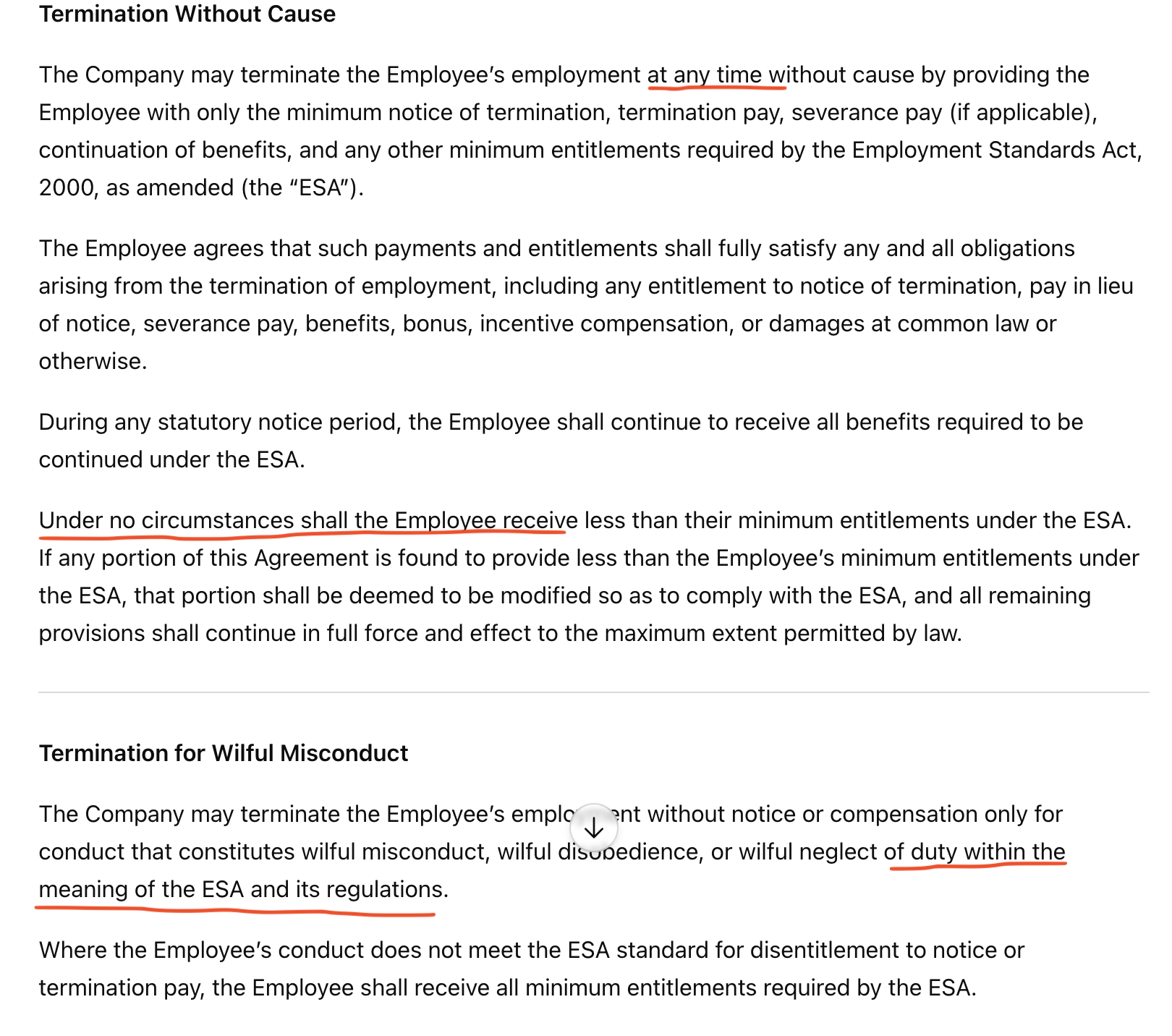
This clause is relatively straightforward. It limits termination entitlements to ESA minimums, includes a saving clause that states that the employee will always be entitled to their ESA minimums, and defines termination for cause narrowly.
But by using the term “at any time”, this clause would very likely be found to be unenforceable (or at the very least, your employee’s lawyer will claim that it’s unenforceable), leading you down the path to litigation.
And even though it includes a saving provision, Ontario courts will generally not give it any weight.
Termination for Cause
Another issue that ChatGPT and Co-Pilot had was with their definition of “for cause” termination. On its face, the clause provided by ChatGPT seems to do a good job. It correctly tried to limit “for cause” terminations to the wording found in O Reg 288/01. The problem is that it left out part of the definition.
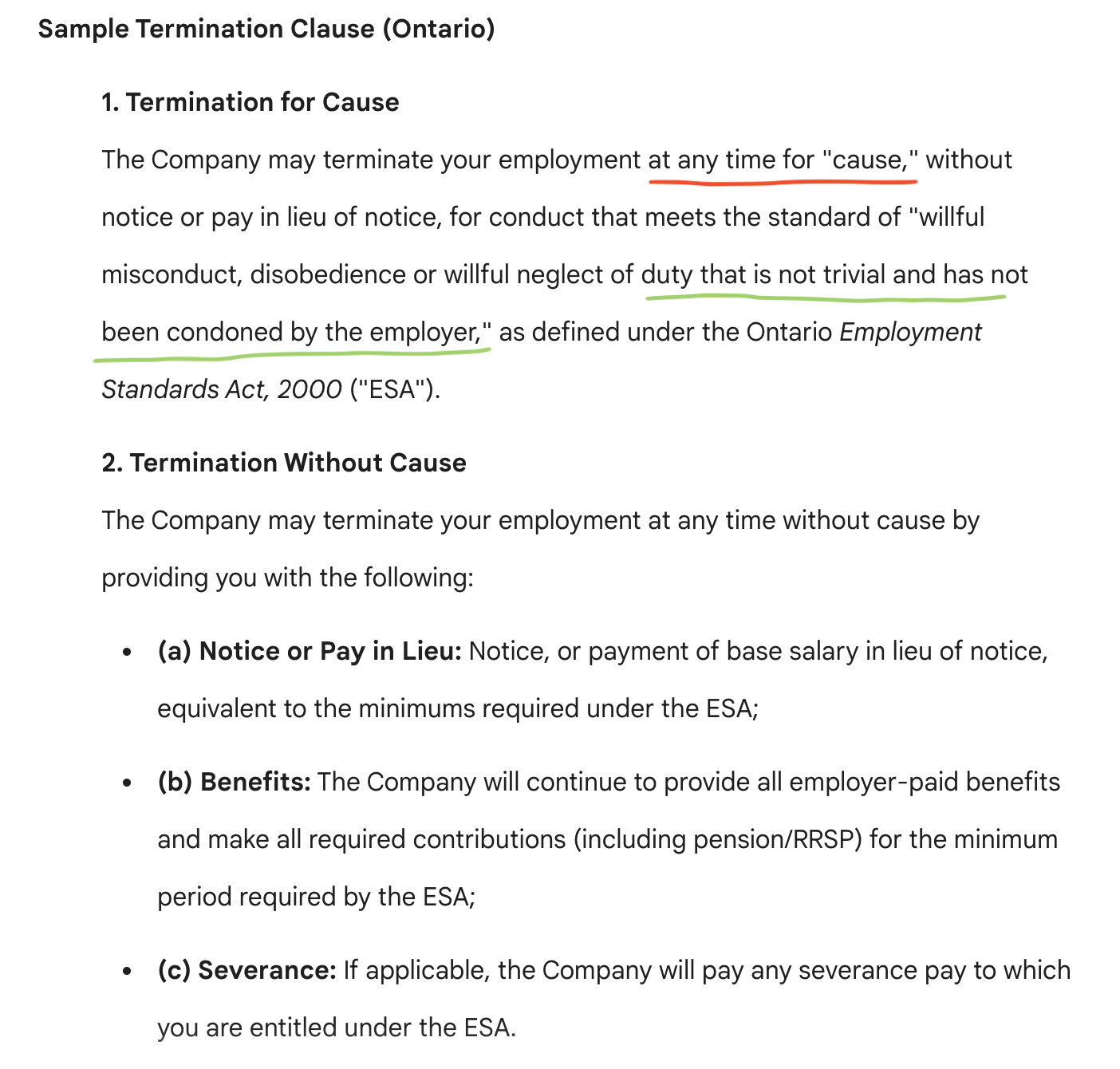
The Regulation states that an employee may be terminated without notice due to wilful misconduct, wilful disobedience, or wilful neglect of duty that is not trivial and has not been condoned by the employer. Although ChatGPT says that these terms are defined by the ESA and its regulations, the omission of the second half of the definition could render the termination clause unenforceable.
Co-Pilot has the same issue that Chat GPT produced:
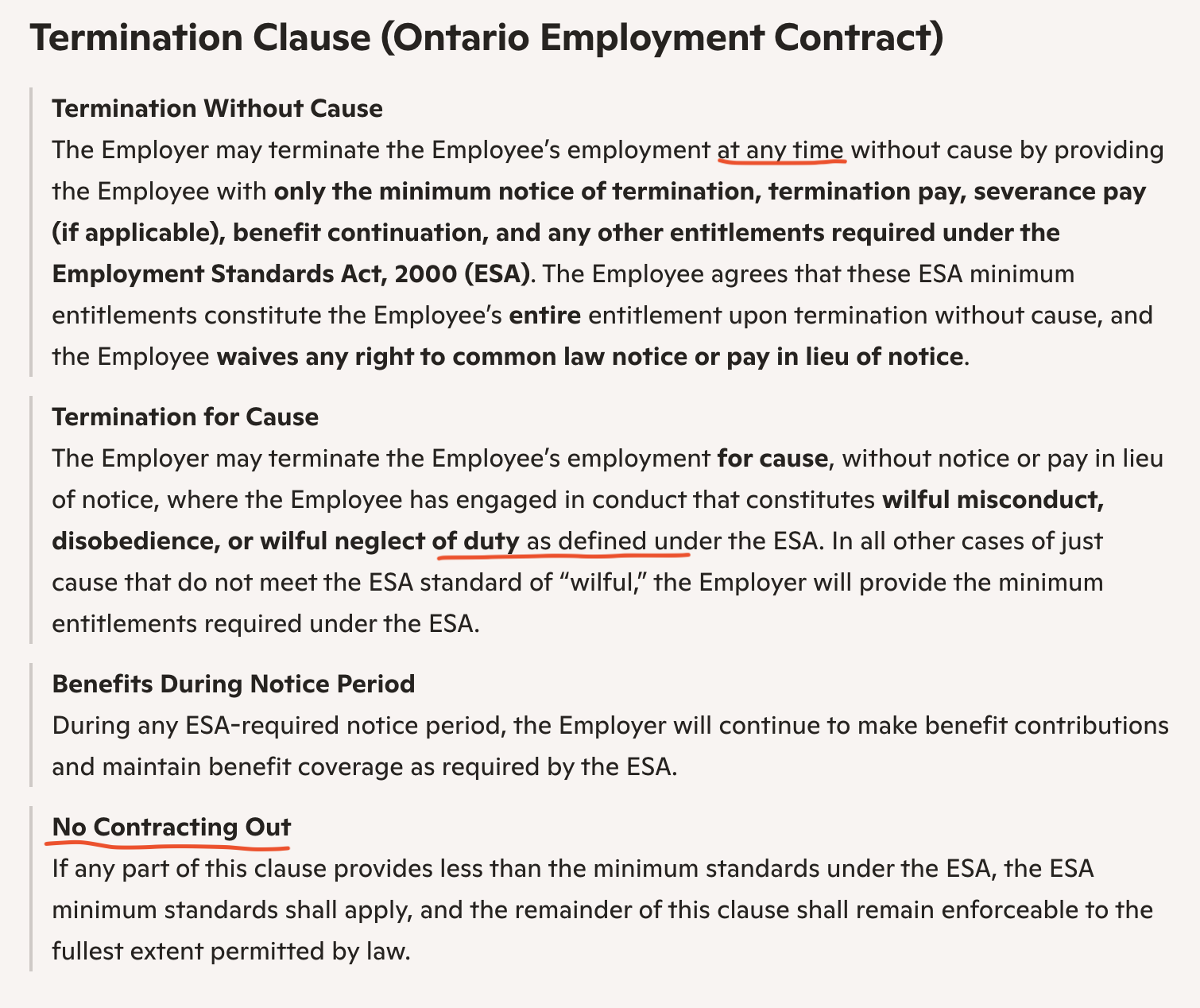
Of the three, only Gemini included the full definition (underlined in green):
Why does this matter? Drafting an enforceable termination clause isn’t just about drafting a clause that ends up holding up in court. Most cases never make it that far. Your real risk with these clauses lies in the uncertainty that they produce. Any minor deficiency give your former employee’s lawyer something to latch onto, giving them room to negotiate a settlement favourable to their client.
Litigation is expensive. It’s often not worth fighting a case through to a trial where you will be on the hook for your own legal fees, an order against you, and part of the employee’s legal fees. That’s why most cases settle. The goal of a well-drafted termination clause is to reduce the ammunition the other side will have to give your business a more predictable settlement range.
Other Pitfalls
And these are just the problems with a single clause. If you’re letting AI draft your entire agreement, it will likely contain countless other mistakes, or just miss something altogether. And that’s not even considering other documents that you need for your business from workplace policies, termination notices, job posting requirements, commission and bonus plans, performance and behaviour management documents, accommodation agreements, releases and settlement documents.
Using AI may seem like it’s saving you time and money on hiring a lawyer, but it may result in higher costs long term, and more protracted litigation.
Alinea On-Call
That’s why Alinea has a subscription service for employers. We give you access to the legal advice you need for your business so you don’t have to rely on AI to draft your documents, all for a predictable monthly rate based on the needs of your business. The goal is to make legal support accessible for businesses of all sizes. It’s like having your own in-house counsel, but without the cost of hiring a full-time lawyer.
Reach out by email, phone, or schedule a free consultation to learn more about Alinea On-Call and ask about our introductory offer.
